


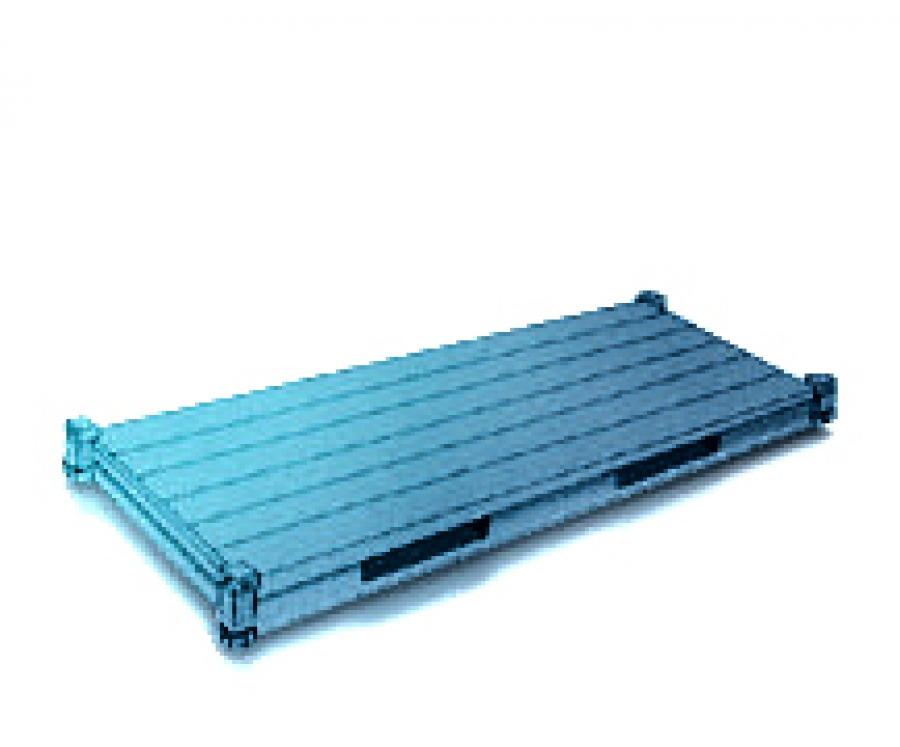
40' Platform Container Specifications
| Specification | Value |
|---|---|
| Platform Length | 12.192 m |
| Platform Width | 2.245 m |
| Platform Height | 0.648 m |
| Door Width | Not applicable |
| Door Height | Not applicable |
| Enclosed Cubic Capacity | Not applicable |
| Tare Weight | 5,700 kg |
| Maximum Cargo Weight | 39,300 kg |
Door dimensions and enclosed cubic capacity are not applicable because the unit has no enclosed cargo space or conventional doors. The listed height refers to the platform structure. Equipment specifications and permitted payloads may vary according to manufacturer, carrier, terminal, route, and inland transport regulations.
Common Uses for Heavy and Oversized Cargo
A 40' platform container may be used for long industrial machinery, large equipment bases, steel structures, fabricated modules, heavy construction components, plant units, pipes, and cargo with dimensions that require unrestricted loading access. It is particularly relevant when side or end walls would interfere with cargo support, loading, or securing.
Such shipments usually require detailed planning through project cargo and OOG transport. Depending on the route, movement may also involve specialized sea freight, terminal handling, permits, and inland transport arrangements.
40' Platform vs 40' Flat Rack
The main difference between a 40' platform and a 40' flat rack container is that the flat rack has two end walls, while the platform has none. The platform therefore provides the greatest loading flexibility from the sides, ends, and top.
A platform may be more appropriate when cargo length, support points, or loading procedures make end walls impractical. A flat rack may be more suitable when its end walls assist with cargo positioning or are compatible with the planned securing system.
For shorter, compact heavy cargo that does not require the full platform length, a 20' platform container may be considered.
Handling and Securing Notes
Platform cargo must be reviewed according to its total dimensions, gross weight, centre of gravity, lifting points, bearing areas, support locations, and lashing plan. A high maximum payload does not mean that the entire weight can be concentrated at one point. Loads must be distributed across suitable support areas within the equipment limits.
Very large or heavy shipments may require shipping line approval, special vessel space, lifting studies, terminal coordination, blocking and bracing, specialized trailers, route surveys, permits, or escorts. Cargo that exceeds standard width, height, or length limits may also be treated as out-of-gauge cargo.
For equipment selection and shipment planning, you can contact SASCO or request a shipping quotation by sharing the cargo drawings, dimensions, gross weight, centre of gravity, lifting points, origin, destination, and delivery conditions.
Frequently Asked Questions
What is a 40' platform container used for?
It is used for long, heavy, oversized, or unusually shaped cargo that requires a reinforced floor and unrestricted loading access.
When is a platform better than a flat rack?
A platform may be better when flat rack end walls would interfere with cargo dimensions, support points, loading access, or securing arrangements.
Can very heavy cargo be shipped on a platform container?
Yes, subject to the equipment payload, concentrated-load limits, weight distribution, carrier approval, terminal capacity, and inland transport restrictions.
What should be checked before using a platform container?
Cargo dimensions, gross weight, centre of gravity, bearing areas, lifting points, support locations, lashing design, carrier rules, terminal requirements, and route restrictions should all be reviewed.